

Building a geo-aware live streaming platform with real-time voting mechanics
Services Provided
Mobile Development, Web Development, Backend Architecture
Project Technologies
Flutter | Ruby on Rails | AWS
Industry Served
Social Media, Live Streaming
Team Composition
1 Full-Stack Developer, 1 Mobile Developer, 1 Designer, 1 Project Manager
Project Duration
January 2021 - October 2022
TLDR
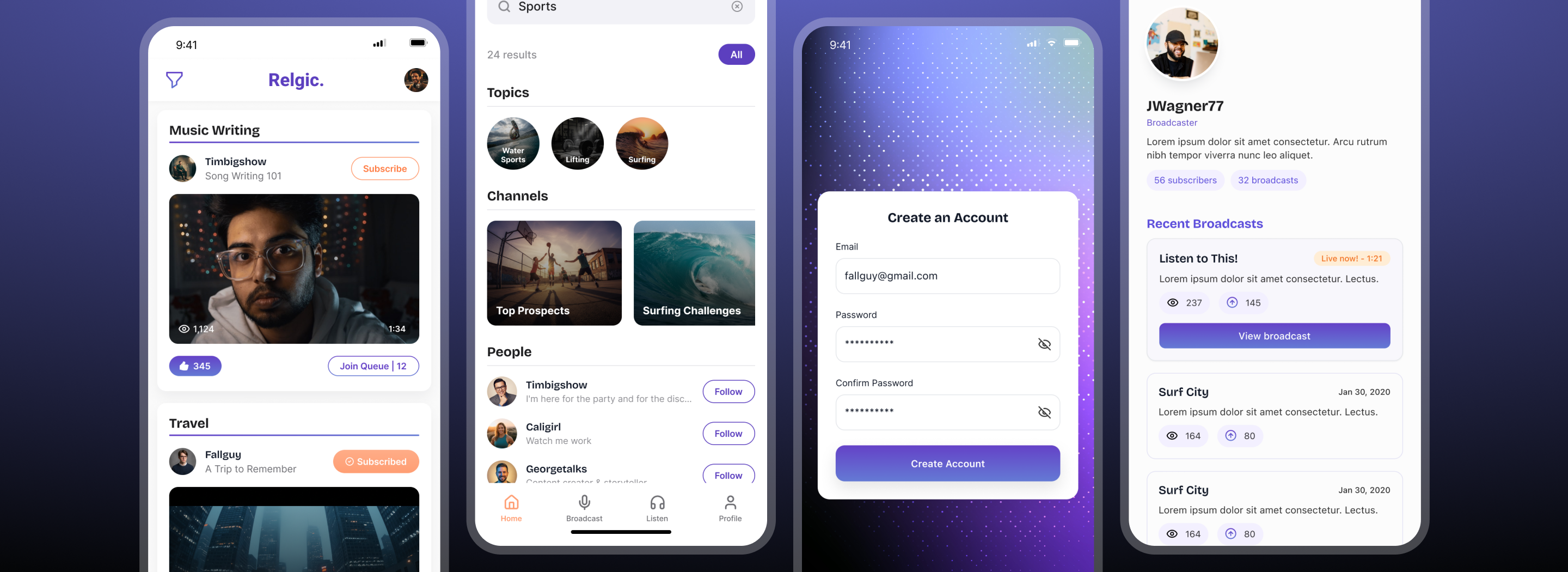
Relgic was a live streaming social platform where viewers voted to determine how long each broadcaster could stay on air, with a geographic queue system that prevented gaming while maintaining local relevance. Twin Sun built the complete platform, handling mobile development for iOS and Android, backend architecture, and real-time coordination across thousands of concurrent users. The technical challenges included real-time vote tallying, dynamic geographic zone calculations that reshuffled the queue with each broadcaster transition, and adaptive quality scaling based on upload bandwidth. The app launched to the App Store and Google Play in 2021. It was a technically interesting build that didn't ultimately find product-market fit, but the execution was solid and the problems we solved were genuinely hard.
The Challenge
Relgic envisioned a live streaming social platform with a twist: instead of letting anyone broadcast indefinitely, viewers would vote to determine how long each broadcaster got to stay on air. Every two minutes, the system would tally thumbs-up and thumbs-down votes — more positive than negative, and you got another two minutes; otherwise, someone else got the mic. The technical complexity ran deeper than just streaming video. The founders wanted geographic awareness baked into the queue system: the next broadcaster couldn’t be a buddy sitting next to you gaming the system, so there needed to be an exclusion zone around the current broadcaster, but also a maximum range so the platform maintained local relevance. Within that geographic donut, queue position was determined by yet another voting mechanism, with viewers upvoting people waiting in line. This meant every time a new broadcaster took over, the geographic zones would shift, the queue would reshuffle based on who now fell within range, and the voting tallies would need to recalculate — all in real time while maintaining smooth video streaming.
Our Solution
Twin Sun broke the problem into manageable pieces. For the streaming infrastructure, we integrated with a specialized video delivery service to handle the heavy lifting, letting us focus engineering effort on the parts that made Relgic unique rather than reinventing video streaming from scratch. The geographic queue logic required careful thought — we built a system that dynamically expanded the eligible broadcaster zone based on queue depth, targeting a minimum number of candidates while excluding the immediate vicinity of the current broadcaster, with upvote counts determining priority within that zone. When broadcasts transitioned, the system recentered the geographic calculation and recomputed the entire queue. Real-time voting presented its own challenges: we needed to reliably count votes across potentially thousands of concurrent viewers, update the broadcaster’s remaining time based on vote tallies, and communicate all of this back to every connected client without lag. We also implemented adaptive quality scaling, detecting each broadcaster’s upload bandwidth and automatically adjusting stream quality to maintain smooth playback, so users with mediocre connections could still broadcast without constant buffering on the viewer end.
The Results
We delivered working iOS and Android applications with the full feature set: channel-based browsing, real-time broadcasting with the voting mechanism, geographic queue management, push notifications, and a companion web viewer. The app launched to the App Store and Google Play in 2021. From a pure technology standpoint, this was one of our more interesting builds — real-time video streaming combined with geographic computation and crowd-sourced queue management presented genuine engineering challenges that we solved cleanly. Unfortunately, the app didn’t find product-market fit and is no longer live. That’s the reality of startup work: not every well-built product finds its audience. But the technical execution was solid, the architecture was sound, and the problems we solved were genuinely interesting.


